The guide · about six minutes
Six ways a label lies to you
None of them are illegal. That is the annoying part.
These checks work on any tub, stick or tablet you can pick up. They work on us too, and check 6 is one we do not pass yet. It is in here anyway.
Is that number the mineral, or the whole thing?
A mineral never comes on its own. It is always stuck to something else. So a label can weigh it two ways. Only one of those is the way you think.
What you want
Magnesium (as magnesium glycinate) 200mg
You get 200mg of magnesium. The brackets tell you the form.
The trick
Magnesium glycinate 200mg
You get 200mg of the whole compound. Only part of that is magnesium.
Which form is it? The cheap one or the good one?
Two brands can both print 200mg of magnesium. You can still have two very different afternoons. The amount is what went in. The form is what you keep.
Magnesium oxide is cheap. Your body takes in about 4% of it.
The other 96% stays in your gut. It pulls water in with it. That is not a side effect. That is how a laxative works. Oxide is sold as one. Glycinate costs more. It absorbs far better.
How many scoops is one serving?
Every number on the panel is for one serving. Not one scoop. Not one stick. One serving, and the brand decides what that means.
Make the serving two scoops and every number on the label doubles.
So check the serving size first. Then find servings per container. Divide the price by that. Now you have a price per serving. Now you can compare two brands honestly.
Read the milligrams. Ignore the percent.
The % DV compares your dose to one made up adult. That adult is having an average day. You are reading this because your days are not.
Potassium is the clearest example. Its daily value is huge, so a genuinely useful dose still shows up as a tiny percent. A small number in that column is not a small dose.
They are not allowed to hide a mineral
A “proprietary blend” lets a brand list what is in the mix without telling you how much of each. Fine for a flavour. Not fine here.
Because minerals are not allowed in the blend.
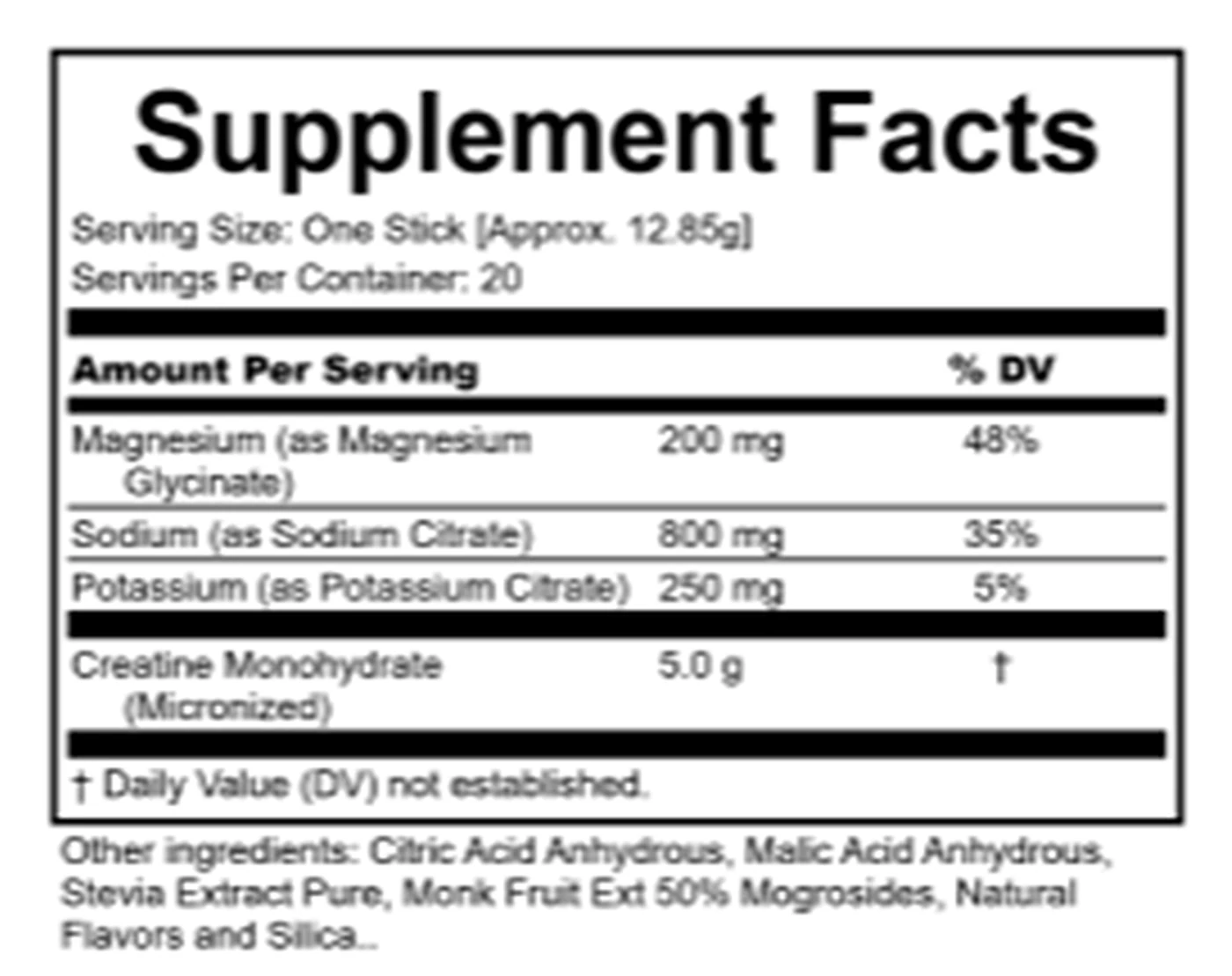
The rules are clear. Every vitamin and mineral gets its own line. Each one gets its own number.
So pick up an electrolyte product. Look for a plain milligram number for sodium, potassium and magnesium. Cannot find one? That is not a secret recipe. Something is wrong.
“Third-party tested” means nothing on its own
Nobody checks that phrase. Anyone can print it. There is no rule about it at all.
Here is what to ask for instead, weakest to strongest.
A certificate of analysis for the batch in your hand. It should list what is in it and how much. It should also cover heavy metals and microbes. Good brands publish it. Or they send it when you ask.
A certification mark like NSF Certified for Sport, Informed Sport or USP Verified. These are real. Each one has a public database. So you can look the product up yourself. You do not have to trust a logo.
They do not all check the same thing. Informed Sport tests every batch. NSF screens against a long banned list. USP checks that what is on the label is what is in the tub.
One catch. A certificate means the label is honest. It does not mean the stuff works for you. Two different questions.

The whole thing, in six lines
- Is the number the mineral, or the whole compound?
- Which form is it, and is it the cheap one?
- How many scoops is a serving, and what does one serving cost?
- Read the milligrams. Ignore the percent.
- Can you see a real number for every mineral?
- Is there a certificate, or only the words?
That is the guide. It works whichever brand you end up holding, which is why it does not end in a discount code.
Sources
- 21 CFR 101.36, nutrition labeling of dietary supplements
- ConsumerLab, elemental versus compound weight in magnesium supplements
- Council for Responsible Nutrition, best practices for proprietary blends
- Operation Supplement Safety, why third-party certification matters
- JAMA, potassium citrate and gastric tolerance
- Absorption of magnesium glycinate compared with oxide